


Walk past a lemon eucalyptus tree and brush its leaves. That citrus punch you smell? It's not just pleasant—it's 80% citronellal, a compound that's been outsmarting mosquitoes for millions of years.

The distinctive peeling bark of lemon eucalyptus reveals patches of white, pink, and cream.
Lemon eucalyptus (Corymbia citriodora, formerly Eucalyptus citriodora) isn't your typical houseplant. It's a biochemical powerhouse wrapped in smooth, powdery bark that sheds in patches to reveal pink and cream undertones. Native to northeastern Australia, this tree has been cultivated worldwide not just for looks, but for what its leaves can do.
The Chemistry That Makes It Special
The essential oil distilled from lemon eucalyptus leaves contains 70-85% citronellal, the highest concentration of any commonly grown plant. Unlike regular eucalyptus species loaded with cineole (that medicinal camphor smell), lemon eucalyptus took an evolutionary detour. Its leaves produce citronellal and citronellol instead—aldehydes and alcohols that give it that distinctive lemon scent without any actual citrus involved.
As the leaves age naturally on the tree, something interesting happens. The citronellal slowly converts into p-menthane-3,8-diol (PMD), a compound that's even better at repelling insects. This is the same process commercial manufacturers use to create oil of lemon eucalyptus (OLE), the only plant-based mosquito repellent recommended by the CDC.
Mosquito Defense That Actually Works
The research is solid. Studies show that 30% OLE products provide similar protection to 15-20% DEET formulations. In field trials in Tanzania, PMD from lemon eucalyptus gave complete protection from Anopheles mosquitoes (malaria carriers) for 6-7.75 hours. Consumer Reports found that several OLE products earned their recommendation by providing at least 5 hours of bite-free protection, with some lasting up to 7 hours.
The mechanism is straightforward: the compounds in lemon eucalyptus interfere with mosquitoes' ability to detect carbon dioxide and body heat—the signals they use to find you. A 2018 study on Aedes aegypti (the mosquito that spreads dengue and Zika) found that exposure to PMD significantly reduced feeding behavior compared to controls.
It's not just mosquitoes. Research shows effectiveness against ticks, including those that carry Lyme disease. In Swedish field tests, blankets treated with lemon eucalyptus oil showed 85% repellency against Ixodes ricinus ticks on day one.
Beyond Bug Spray: Other Uses
The antimicrobial properties of citronellal have made lemon eucalyptus useful in traditional medicine. Aboriginal Australians have used eucalyptus leaves for centuries in various applications. Modern research has confirmed antibacterial and antifungal activities, though these effects are stronger in processed essential oils than in the fresh leaves themselves.
In Brazil and China, where most commercial production happens, lemon eucalyptus is also valued for:
- Honey production (the flowers are rich in nectar)
- Durable timber for construction and flooring
- Perfumery and soap making
- Sustainable essential oil harvest
Growing Lemon Eucalyptus at Home
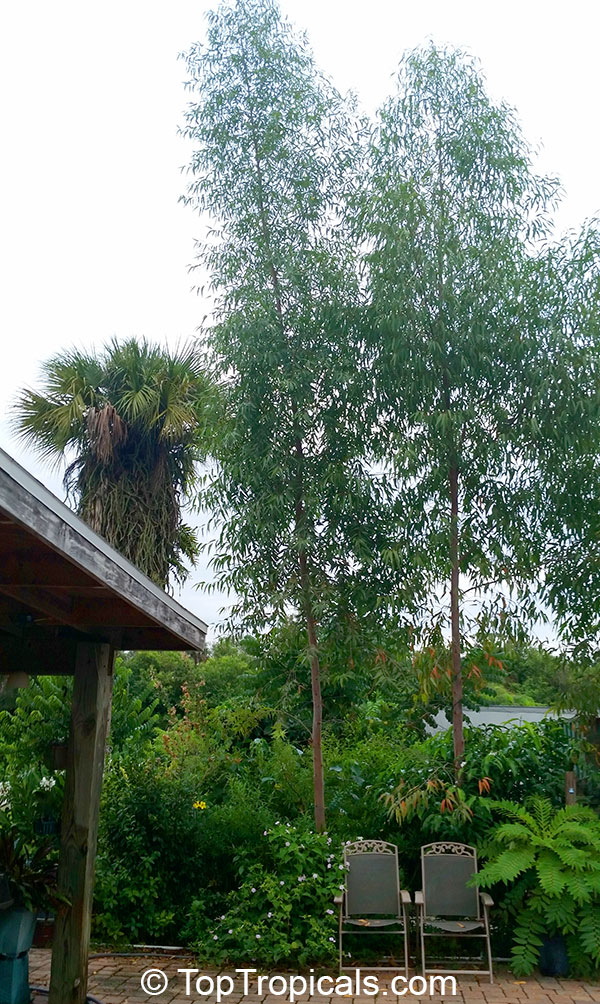
The good news: lemon eucalyptus is surprisingly manageable in containers, despite reaching 80-150 feet in its native habitat. With regular pruning, you can keep it at 3-4 feet indoors or 6-8 feet in a patio container.
Starting from Seed
Lemon eucalyptus seeds are tiny—about 5,000 per ounce—and need no soil covering to germinate. Here's what works:
- Timing: Start seeds 10-12 weeks before your last frost date
- Soil temperature: Keep between 70-75°F for best results
- Sowing: Scatter 1-2 seeds per cell, press lightly into soil, cover with a thin layer of sand
- Germination: Expect sprouts in 14-21 days (sometimes up to 84-98 days for slower batches)
- Seedling care: Remove humidity dome once sprouted. Eucalyptus seedlings are prone to damping off, so provide bright light and good air circulation
Container Growing (The Best Method for Most Gardeners)
Container culture solves the biggest problem with lemon eucalyptus: its tendency to become a giant tree.
Pot Selection: Choose a large container with excellent drainage holes. These trees grow fast—plan for a pot you'll still like in several years, as they don't transplant well.
Soil: Well-draining mix is critical. Eucalyptus naturally grows in nutrient-poor soils, so skip heavy fertilization. Container plants benefit from one feeding in spring.
Light: Full sun is non-negotiable. Place less than one foot from a south-facing window indoors, or outside in a spot that gets 6-8 hours of direct sun. Shade will kill it.
Water: Let the top few inches of soil dry between waterings. In containers, this usually means watering when you stick your finger in the soil and it feels dry past the first knuckle. New plants need regular water for the first year, but established trees handle drought well.
Pruning: This is how you control size. Prune in late winter or early spring after any flowering. Pinching back young growth encourages bushier form. The bonus: you get fresh aromatic material for sachets, outdoor sprays, or just to crush and smell.
Climate Considerations
Lemon eucalyptus is hardy to Zone 8 (down to about 10-20°F). In colder zones, treat it as a container plant that summers outdoors and winters inside in a bright, cool spot. Some varieties can handle brief exposure to light frost, but prolonged freezing will damage or kill the plant.
The ideal climate mimics its native range: annual lows of 9-19°C (48-66°F), annual highs of 19-35°C (66-95°F), and moderate humidity. That said, gardeners successfully grow it in Texas heat, California sun, and even as far north as Zone 7 with winter protection.
Outdoor Planting (Zones 8-11)
If you're in a warm enough climate for permanent outdoor planting:
- Plant in full sun in well-draining soil
- Space trees 18-24 inches apart if planting multiples
- Water regularly the first year while establishing
- In windy areas, plant young to avoid wind rock as the tree matures
- Prune to maintain desired height and encourage bushy juvenile foliage (which is more aromatic than mature leaves)
The narrow, lance-shaped leaves are lemon-scented when crushed.
What to Expect
Growth is fast. A containerized lemon eucalyptus can shoot up 6-8 feet in its first season if conditions are right. The leaves start out broader and rounder on young plants, then develop into the characteristic narrow, lance-shaped form as the tree matures. Both leaf types are aromatic, but juvenile foliage tends to have a stronger scent.
The smooth bark is ornamental on its own—starting white to pale gray, it sheds in thin flakes to reveal patches of pink, coppery, or cream color underneath. In winter (or late winter to early spring in greenhouse conditions), small white flowers appear in clusters. They're not showy, but bees love them.
Practical Uses for Home Growers
Once established, you'll have a steady supply of aromatic leaves. Crush a few and tuck them under your hat before a hike—it genuinely works as a personal mosquito deterrent. Hang small bundles of fresh or dried branches near outdoor seating areas. The scent alone helps reduce mosquito presence.
Fresh branches work beautifully in floral arrangements, and leaves can be dried for potpourri or sachets. Some gardeners make simple DIY sprays by steeping crushed leaves in witch hazel or vodka (though remember, this won't be as effective or long-lasting as commercial OLE products).
The Sustainability Angle
Commercial lemon eucalyptus cultivation, particularly for essential oil production, happens mainly in Brazil and China through sustainable harvesting practices. The trees grow quickly, produce abundant foliage, and can be coppiced (cut back to stimulate new growth) rather than felled.
For home growers, the plant offers a renewable source of natural insect deterrent without the environmental concerns of synthetic pesticides. One established tree can provide fresh material for years with minimal inputs—just sun, occasional water, and annual pruning.
Why It Might Be Your New Favorite
Lemon eucalyptus delivers on multiple levels. It's visually striking with that peeling, multi-toned bark. The fragrance is intense enough to notice from feet away but pleasant rather than overwhelming. The science backing its mosquito-repelling properties is legitimate—not marketing hype.
For plant people who appreciate function alongside form, it's hard to beat. You get an attractive specimen, a conversation starter about plant biochemistry, and a practical tool for summer evenings outdoors. The fast growth means results within months, not years. Container culture keeps it manageable for renters or gardeners with limited space.
Most importantly, growing it yourself connects you to the chemistry happening in those leaves—millions of years of evolutionary refinement producing compounds that just happen to work perfectly for our modern need to avoid mosquitoes.
That's the kind of plant worth making space for.
Have you grown lemon eucalyptus? What's been your experience with it as a mosquito repellent or ornamental? Drop your observations in the comments.