


Common Blue Violet (Viola sororia) pushes up through lawns and garden edges across North Carolina every spring. Most people reach for the broadleaf herbicide. That decision has a cost most people don't know about.
These violets are the primary larval host plants for several fritillary butterfly species native to the Southeast. Without them, the caterpillars have nothing to eat. The plant you're spraying is doing real ecological work.
What You're Looking At
Common Blue Violet is a low-growing native wildflower with heart-shaped leaves and purple-blue blooms that appear from March through May. It grows in lawns, woodland edges, disturbed areas, and shaded garden beds throughout eastern North Carolina. You've almost certainly walked past it in your own yard.
It spreads by seed and short rhizomes, which is why it keeps returning to the same spots year after year. It has no serious pest problems and requires no maintenance. The reason most people remove it is that it grows where they didn't plant it.
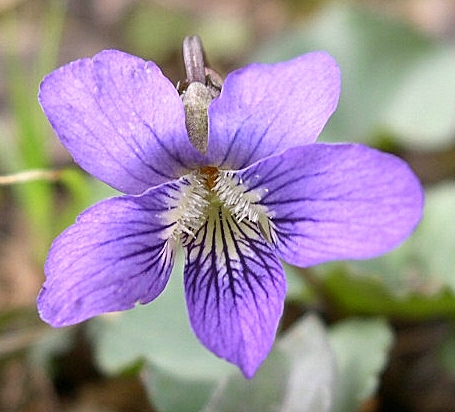
A spring-blooming native wildflower found in lawns, woodland edges, and moist disturbed areas across NC. Leaves and flowers are edible. The primary larval host plant for multiple fritillary butterfly species in the Southeast. Thrives in part shade and average to moist soil.
The Butterflies That Depend on Them
Fritillary butterflies in the genus Speyeria are Viola specialists. Their caterpillars eat violet leaves and nothing else. Females lay eggs near violets in late summer. The eggs hatch, the tiny larvae go dormant through winter, and then they emerge in spring to feed on new violet growth.
The timing is exact. If violets are gone in spring, the caterpillars starve. There is no substitute host plant for these species.
The Variegated Fritillary (Euptoieta claudia) is more flexible. It uses Viola along with other plants, including Passionflower (Passiflora incarnata). It is one of the more common fritillaries in coastal North Carolina and one you're likely to see in your yard from late spring through fall. Violets are still a core part of its larval diet.
What looks like a lawn weed is a food source that a generation of caterpillars is counting on.
The Herbicide Problem
Standard broadleaf herbicides used in lawn care target plants like dandelion, clover, and violet. They work. Violet is gone within days.
The problem is that fritillary caterpillars emerge from dormancy looking for the same plants they hatched near. If those plants are gone, they die. These larvae are tied to one small patch of ground — there's no moving on to the next yard.
This isn't an argument against all lawn care. It's a case for leaving at least one unmowed, unsprayed patch wherever violets are already growing. A clump two feet across is enough to make a difference.
Other Native Violets Worth Knowing
North Carolina has over 20 native violet species. Two others that come up often for different garden conditions:
Named for its deeply divided, bird's-foot-shaped leaves. Grows in well-drained, lean soils — natural habitat includes longleaf pine savannas and open roadsides. Large lavender flowers with distinctive orange stamens. A good choice for dry, sunny spots where V. sororia won't establish.
A native violet found in moist, open habitats across coastal North Carolina, including pond margins, seeps, and wet meadow edges. Smaller flowers than V. sororia and tolerates wetter feet. A good fit for low spots in the yard that stay damp through spring.
What to Grow Alongside Violets
If you want to extend the habitat value of a violet patch, a few native companions work well in similar conditions. Passionflower (Passiflora incarnata), also called Maypop, is a native vine that serves as an additional larval host for Variegated Fritillary and provides nectar for adult butterflies. It spreads aggressively in open ground, so give it a fence or trellis and some room.
Native sedges (Carex spp.) fill in shaded areas where violets grow without competing with them. They provide structure and support for other ground-layer invertebrates. Common choices for coastal plain yards include Lax Sedge (Carex laxiflora) and Broad-leaf Sedge (Carex platyphylla).
None of this has to be a formal garden bed. A shaded corner left alone will do most of the work.